
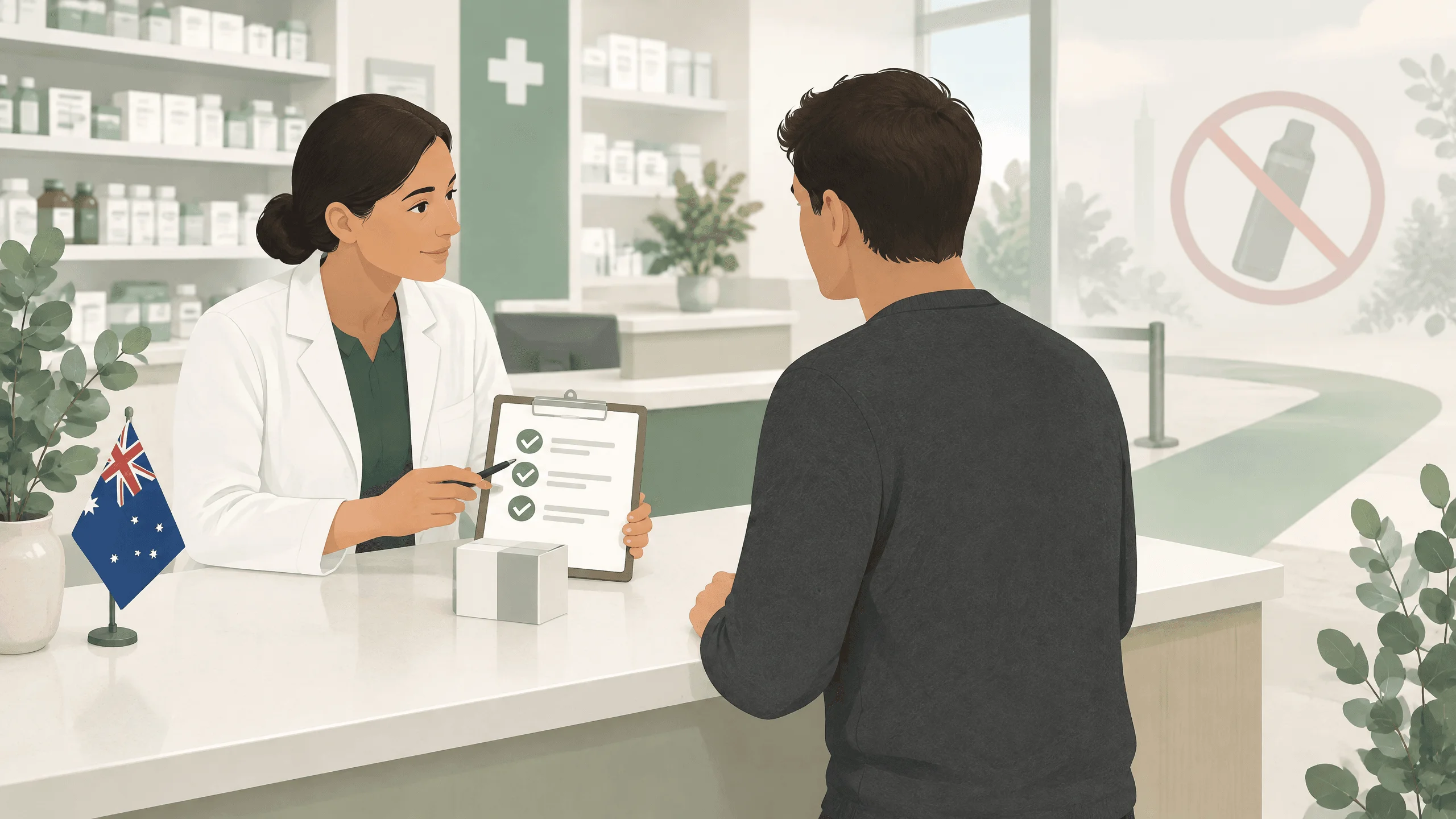
The short answer: can you buy vapes in Australia?
Yes, some adults may be able to access certain therapeutic vapes through participating pharmacies, but Australia does not have a normal retail market for vaping products. The answer to “Can you buy vapes in Australia?” depends on the product, its intended therapeutic purpose, nicotine concentration, your age, the supply pathway and the law in your state or territory.
Since 1 July 2024, vapes and vaping products can only be sold through pharmacies for the therapeutic purpose of helping people quit smoking or manage nicotine dependence. Under this framework, tobacconists, vape shops and convenience stores cannot legally sell vapes or vaping products.
This means that an online listing or a product being available overseas does not prove that it can be lawfully supplied in Australia. Disposable and non-therapeutic vapes are subject to much stricter restrictions, including prohibitions on commercial importation, manufacture, supply, commercial possession and advertising.
How Australia’s vape system works
Australia’s system is based on therapeutic supply, not ordinary consumer sales. A therapeutic vape is intended for smoking cessation or the management of nicotine dependence. It must be supplied through an authorised pathway and must meet the relevant product standards.
The Australian Government Department of Health and Aged Care explains that all vapes and vaping products, including products without nicotine, are restricted to pharmacy supply for these therapeutic purposes. The rule is therefore not limited to nicotine vape products.
The Therapeutic Goods Administration (TGA) also states that therapeutic vapes are generally unapproved goods. There are currently no vapes for smoking cessation or nicotine-dependence management included in the Australian Register of Therapeutic Goods (ARTG). A product can therefore be lawfully supplied through an applicable pathway without being an ARTG-approved medicine.
That distinction matters. “Available through a lawful pathway” does not mean “approved by the TGA” It also does not mean every vape advertised online is legal.
What participating pharmacies can supply
From 1 October 2024, participating pharmacies may supply certain therapeutic vapes to adults aged 18 years or over without a prescription when the nicotine concentration is 20 mg/mL or less, the supply is clinically appropriate, and state or territory law allows it.
A pharmacy consultation is part of this process. The pharmacist may discuss the product, dosage, smoking history, nicotine dependence, other quit options and possible interactions with medicines. The pharmacist must be satisfied that the product is an appropriate therapeutic option.
The relevant pharmacy supply requirements generally include the following:
•The patient must be at least 18 years old.
•The nicotine concentration must be no more than 20 mg/mL for this pharmacist-only pathway.
•The pharmacist must confirm identity and age.
•The patient must receive information about alternatives and appropriate use.
•The patient must be told that the product is not an ARTG-listed or registered good.
•Supply must not exceed one month’s supply in a month.
•The supply must comply with the relevant state or territory law.
Pharmacists are not required to stock or supply therapeutic vapes. A pharmacy may decide not to supply a product, may require a prescription, or may refer a person to a doctor or another health professional.
When is a prescription required?
A prescription is required in some circumstances. This includes therapeutic vapes with a nicotine concentration above 20 mg/mL. People under 18 years also generally require a prescription to access vapes, where state and territory laws allow it.
A prescription may also be required because of state or territory rules, the patient’s clinical circumstances or the particular therapeutic product. The TGA identifies prescription pathways that may involve a medical practitioner or nurse practitioner, including the Special Access Scheme and Authorised Prescriber pathways.
A prescription does not guarantee that a pharmacy will dispense a product. The pharmacist must be able to lawfully supply it, and pharmacists cannot be compelled to stock or dispense therapeutic vapes. The product must also be supplied in its final dosage form through the appropriate pathway.
If you are unsure whether you need a prescription, speak with a pharmacist or medical practitioner. Do not rely on a seller’s product description as a substitute for professional advice.
Nicotine concentration rules
The most important nicotine rule for adults is the 20 mg/mL threshold. Adults may be able to access a therapeutic vape at or below that concentration without a prescription through a participating pharmacy, where the supply is clinically appropriate and permitted by local law.
A therapeutic vape above 20 mg/mL requires a prescription, regardless of the person’s age. The concentration rule is only one part of the legal framework. The product’s purpose, packaging, ingredients, device type, labelling and supply route must also be considered.
The Australian Government also states that therapeutic-vape flavours are restricted to unflavoured, mint, menthol and tobacco, and that products must follow plain pharmaceutical packaging requirements. These rules mean that product names, flavour descriptions and promotional packaging can not be used as evidence that a vape can be legally sold.
The TGA’s information for pharmacists explains that products supplied through the pharmacist pathway must comply with relevant requirements and that state or territory law can impose additional obligations.
Rules for people under 18
People under 18 require a prescription to access vapes where state and territory laws allow. Some jurisdictions may impose additional restrictions, so the federal rule is not the entire answer.
The age requirement exists to support medical advice and supervision. Vaping content, advertising and product presentation should not target young people. Businesses and publishers should avoid youth-oriented imagery, slang, cartoons, social media trends and lifestyle claims that could encourage youth uptake.
Parents, carers and schools can find more information through the Australian Government’s vaping resources. Anyone concerned about a young person’s vaping should seek advice from a doctor, pharmacist or a recognised quit-support service.
What about online or overseas purchases?
An overseas website may display a vape for sale, but that does not mean the product can lawfully be imported or supplied in Australia. The TGA’s reform summary states that the 2024 Act prohibits the importation, domestic manufacture, supply, commercial possession and advertising of disposable single-use and non-therapeutic vapes.
Import rules can involve customs requirements, therapeutic-goods rules and other legal controls. A buyer should not assume that a small parcel, a “nicotine-free” label or a website offering Australian delivery makes the transaction lawful.
The Australian Government also warns that illegal e-cigarettes may list their ingredients inaccurately. Some products labelled nicotine-free may contain nicotine, and liquids or aerosols may contain substances that have not been tested for safety.
For that reason, online availability is not a reliable legal test. If you are considering a therapeutic vape for smoking cessation or nicotine dependence, use an appropriate Australian pharmacy or health-professional pathway and confirm the current requirements for your state or territory.
What about disposable vapes?
Single-use disposable vapes cannot be purchased through a pharmacy under the Australian Government’s consumer guidance. Federal reforms prohibit the commercial importation, domestic manufacture, supply, commercial possession and advertising of disposable single-use and non-therapeutic vapes.
Changing the nicotine strength does not avoid this restriction. A disposable vape can be restricted even if it is labelled nicotine-free. A large puff count, colourful packaging or flavour range is also not evidence of lawful supply.
Consumers should be particularly cautious about social media listings, informal sellers and websites that promote disposable products directly to Australian customers. Advertising a product and supplying it may both create compliance issues.
Why state and territory rules matter
Commonwealth law creates the national therapeutic-vaping framework, but state and territory law affects prescribing, dispensing, supply, age restrictions and pharmacy practice. Rules can vary depending on where the patient lives, where the pharmacy operates and whether the person is under 18.
The TGA recommends that pharmacists check the requirements of the relevant state or territory health department. The same general product may therefore be subject to different practical requirements in New South Wales, Victoria, Queensland, Western Australia, South Australia, Tasmania, the Australian Capital Territory or the Northern Territory.
Before relying on general information about buying a vape in Australia, check:
1.whether the product is therapeutic and intended for smoking cessation or nicotine dependence;
2.whether the supply is through a participating pharmacy or a valid prescription pathway;
3.whether the nicotine concentration is above or below 20 mg/mL;
4.whether the product is a prohibited disposable or non-therapeutic vape;
5.whether the product appears on the current TGA-notified vape list; and
6.whether your state or territory has additional requirements.
Inclusion on the TGA notified vape list is not the same as ARTG approval. The TGA notified vape list states that notified products are unapproved therapeutic goods and have not been assessed by the TGA for quality, safety, efficacy or performance in the same way as ARTG-listed products.
Where to verify the latest information
The best starting points are the Australian Government Department of Health and Aged Care, the TGA vaping hub and the health department for your state or territory.
For current federal guidance, review:
•the TGA information for pharmacists; and
•the TGA has notified the vape list.
Information should be checked again before acting because the regulatory framework and notified product information can change.
Frequently asked questions
Can you buy vapes in Australia without a prescription?
Some adults aged 18 years or over may access therapeutic vapes containing no more than 20 mg/mL nicotine without a prescription through a participating pharmacy, where clinically appropriate and where state or territory law allows. This exemption does not apply to all vapes or to disposable products.
Can I buy a vape from a tobacconist or vape shop?
No. Under the federal framework, vapes and vaping products can only be sold through pharmacies for the therapeutic purposes of smoking cessation or managing nicotine dependence. Tobacconists, vape shops and convenience stores cannot legally sell vapes under this framework.
Do I need a prescription for a nicotine vape in Australia?
A prescription is required for therapeutic vapes above 20 mg/mL nicotine and is generally required for people under 18 where access is permitted. Other prescription requirements may apply under state or territory law or because of a person’s clinical circumstances.
Are disposable vapes legal in Australia?
Disposable single-use and non-therapeutic vapes are subject to prohibitions on commercial importation, domestic manufacture, supply, commercial possession and advertising. Single-use disposable vapes cannot be purchased through a pharmacy under the Australian Government’s consumer guidance.
Can I order a vape from an overseas website?
An overseas website listing a product does not prove that it can be lawfully imported or supplied in Australia. Import rules apply, and disposable or non-therapeutic vapes are subject to prohibitions. Check official TGA and customs guidance before considering an import.
Conclusion
So, can you buy vapes in Australia? Some adults may be able to access certain therapeutic vapes through a participating pharmacy, generally with a pharmacist consultation and subject to nicotine limits and local law. Other vapes, especially disposable and non-therapeutic products, are subject to much stronger restrictions.
If you are considering vaping for smoking cessation or nicotine dependence, speak with a pharmacist or doctor and review the latest official guidance. Understanding the current rules is the best first step before making a decision.